
In August, Katarzyna Kaczmarek-Majer participated in the well-known the International Joint Conference on Artificial Intelligence and the European Conference on Artificial Intelligence (IJCAI-ECAI 2026), which took place in Bremen, Germany. The event provided an international forum for presenting advances in AI and discussing their scientific and societal implications. Her contributions focused on explainable and trustworthy AI for healthcare, combining methodological research with questions of transparency and reliability in medical applications.
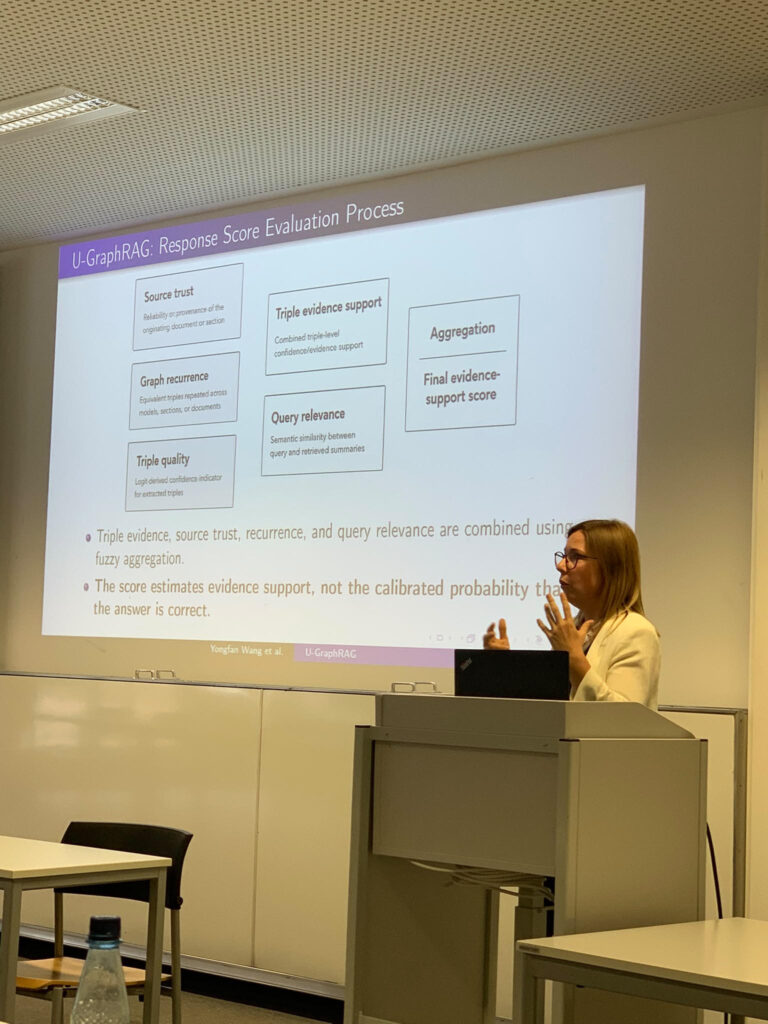
Katarzyna presented “U-GraphRAG: Evidence-Support Estimation in a Medical GraphRAG System,” co-authored with Yongfan Wang, Michał Chojnicki, Paweł Burchardt, Yanwu Ren, and Marek Z. Reformat. The work introduces a framework that estimates how strongly available evidence supports AI-generated answers to medical questions. It combines a knowledge graph extracted from medical documents with indicators of confidence, source reliability, recurring evidence, and relevance to the question. Fuzzy aggregation operators integrate these signals into an interpretable evidence-support score accompanying each answer. Experiments using synthetic medical question-answering scenarios showed that the approach could distinguish well-supported answers from those with weaker evidence, demonstrating its potential to improve the transparency of medical AI systems.
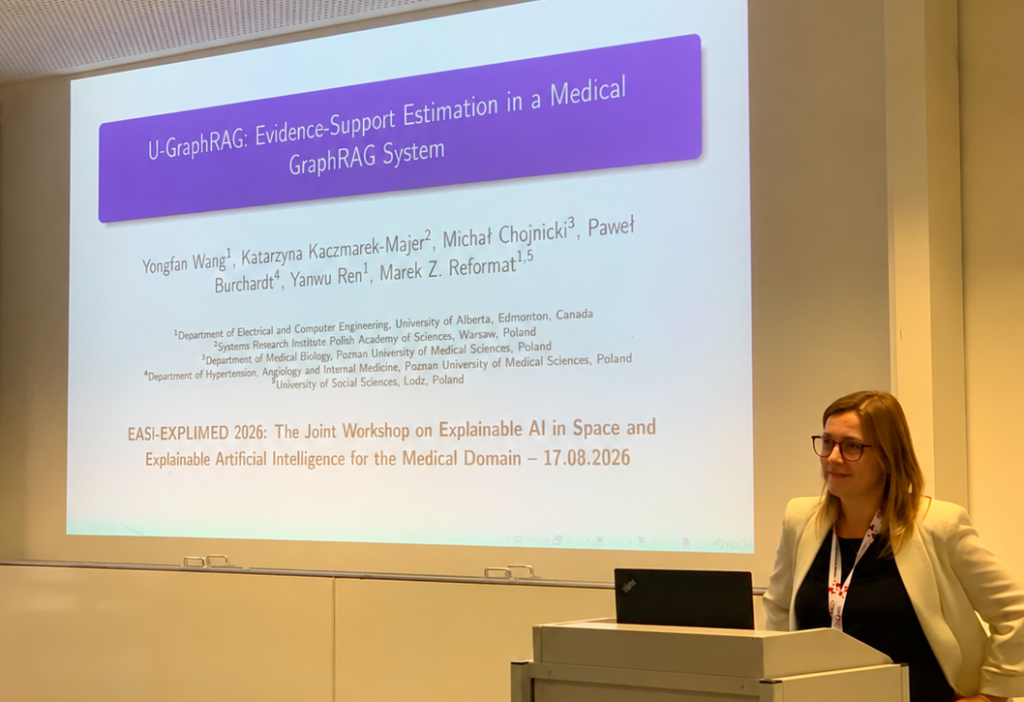
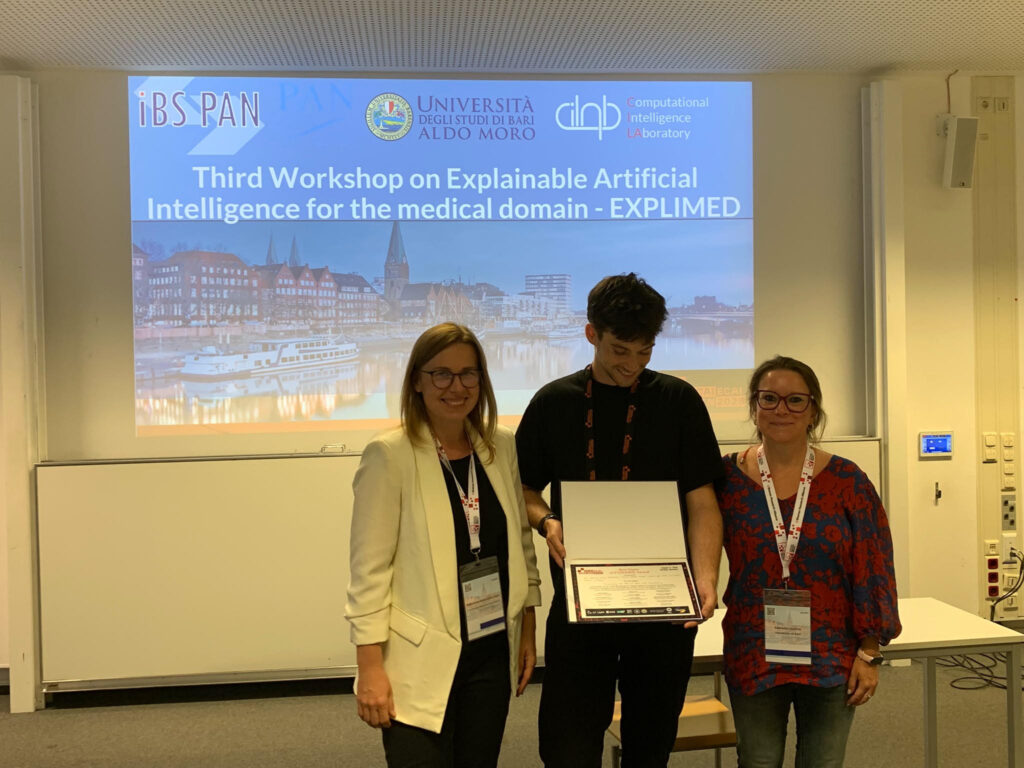
This work was presented with the Third Workshop on Explainable Artificial Intelligence for the Medical Domain (EXPLIMED 2026) bringing together researchers working on transparent and clinically meaningful AI. This year EXPLIMED was held in collaboration with the Workshop on Explainable AI in Space (EASi), the event encouraged exchange across application domains. The programme featured 10 papers selected from 22 submissions, alongside a keynote by Prof. Jerzy Stefanowski on evaluating explanation methods for static and evolving models. Discussions highlighted the need for rigorous evaluation, collaboration with domain experts, and explanations that support users in assessing AI outputs.
ExplainMe aims to support the monitoring of mental health through explainable analysis of speech. Beyond detecting changes in acoustic features, such systems need to communicate how strongly the available evidence supports an alert. The evidence-support estimation approach explored in U-GraphRAG offers a methodological direction for making this uncertainty more transparent. Adapting these principles to speech monitoring could help clinicians distinguish well-supported indications of mood changes from alerts that require additional information or closer review, supporting informed use of ExplainMe in clinical practice.