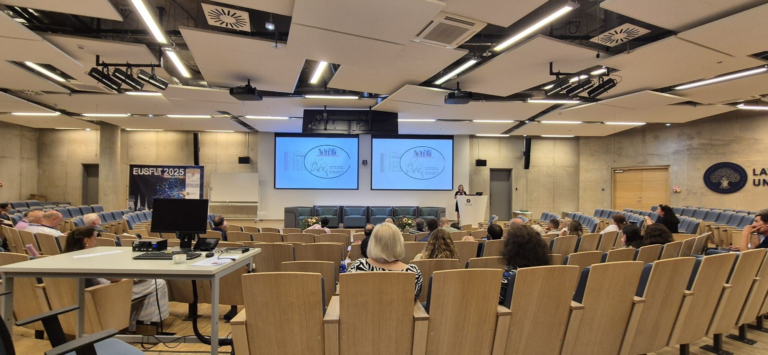

The 2025 IFSA World Congress and NAFIPS Annual Meeting took place from August 16 to 19 in Banff, Canada – in the heart of the Rocky Mountains, a region widely regarded as one of the most stunning and picturesque in the world. Our PhD Researcher Filip Wichrowski took part in this conference dedicated to fuzzy information processing, which brought together many prominent speakers from around the globe, who presented their most recent and relevant achievements in a beautiful campus setting that opened onto one of the most breathtaking panoramas imaginable. The conference was a truly insightful experience for Filip Wichrowski; “I will not easily forget it,” says Filip.
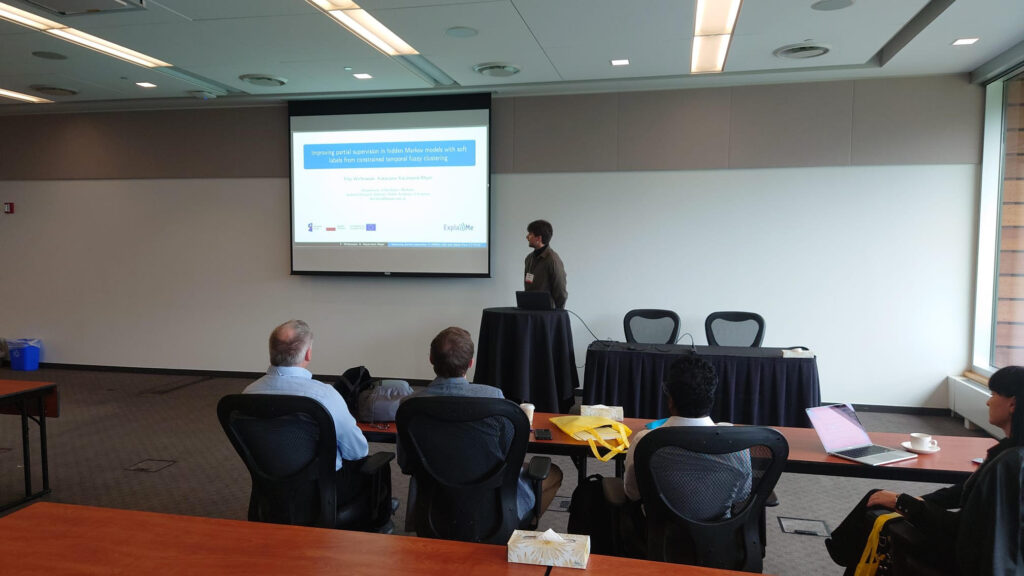
The program was thoughtfully designed and offered a wide range of topics – from theoretical works and applied methods to research on integrating fuzzy systems with large language models. I had the great opportunity to give a talk presenting my recent work, and the discussion that followed was fruitful and left me with many new ideas. The presence of many young researchers from around the world allowed me to exchange ideas and perspectives, which gave me valuable inspiration for my own research.
Filip presented our research dedicated to “Improving Partially Supervised Hidden Markov Models with Soft Labels from Temporal Fuzzy
Clustering“. Hidden Markov Models are widely used latent-variable models that provide flexible approaches to learning from sequential data. However, standard HMM training typically relies on either fully supervised or fully unsupervised methods, both of which can be suboptimal in many real-world settings where data labelling is often expensive or imperfect. We propose a novel and consistent semi-supervised HMM training strategy that shifts the burden of partial labelling from the forward–backward recursions to the emission probabilities. To improve model performance, especially in low-label regimes, we construct the weight matrix using soft cluster assignments obtained through fuzzy pre-clustering of the data. Specifically, we employ the Fuzzy C-Means (FCM) algorithm enhanced with partial supervision and temporally smoothed membership values to reflect the underlying temporal structure. The resulting membership values either directly define the weight matrix or guide its construction in subsequent steps.
Slides are available here: