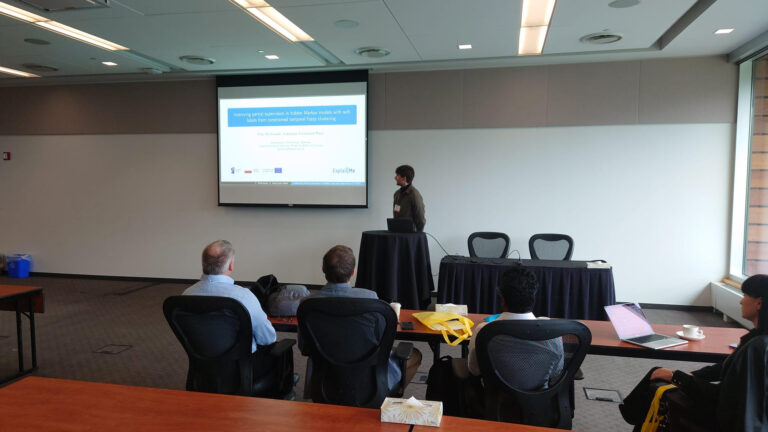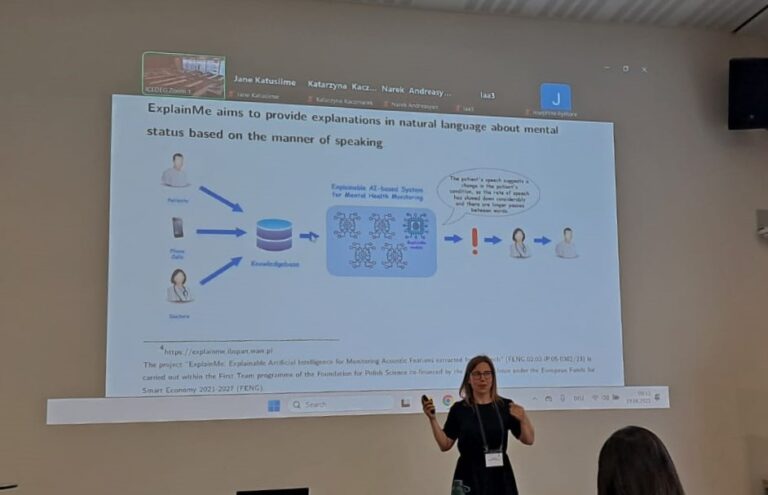

In December, Filip Wichrowski, a PhD researcher, participated in the Mathematical Statistics 2025 conference, one of the principal national events in the field of statistics in Poland. The conference is organized under the patronage of the Statistics Committee of the Committee on Mathematics of the Polish Academy of Sciences, with the 2025 edition co-organized by leading academic institutions, including AGH University of Kraków, the University of Warsaw, and the Polish Mathematical Society. The event constitutes a recognized forum for the presentation and critical assessment of current research by the Polish statistical community, including contributions evaluated by established experts in the field.

During the conference, Filip Wichrowski presented the results of his ongoing research concerning methodological extensions of Hidden Markov Models (HMMs). HMMs are a well-established class of statistical models for time series analysis, widely applied in domains such as speech recognition and bioinformatics. Their continued relevance stems from their mathematical rigor, interpretability, and modeling flexibility. In our work, we aim to address frequent limitations: the reliance on fully unsupervised learning, which precludes the incorporation of auxiliary information about latent states, and the assumption of geometrically distributed state durations, which restricts applicability o HMMs in modeling processes with more complex temporal structures.
The research presented addresses both of these limitations. First, a non-homogeneous Hidden Markov Model (IHMM) is considered, in which the transition probabilities depend explicitly on the time already spent in a given state. This formulation allows for a more flexible representation of state duration distributions. Second, a partially supervised learning framework is proposed through the introduction of a weighting matrix that modifies emission probabilities based on available partial information about hidden states. This approach enables the integration of additional information while preserving the probabilistic structure of the model.
The methodology was validated using simulated datasets characterized by varying distributions of state durations. The empirical results demonstrate that the proposed approach achieves improved predictive performance relative to both fully unsupervised models and partially supervised approaches based on classical HMM formulations.